Hold your active hand palm-up and look at the centre of the palm. Now look for a line that rises vertically — running up the palm roughly toward the base of the middle finger. It may be long or short, deep or faint, clear or barely there. Or it may not be there at all.
Start with that last possibility, because it matters.
Absence is normal
A significant number of people have no fate line, or have only a trace of one in one section of the palm. This is not a deficit. It does not mean the person lacks direction, or has a diminished life, or faces worse outcomes than someone with a strong fate line.
Fincham is direct on this point in The Spellbinding Power of Palmistry (2005): the absence of a fate line "does not mean a lack of destiny or a wasted life." West, writing in The Complete Illustrated Guide to Palmistry (1998), frames it as meaning the person's life is "not governed by routine" — a life that is self-directed, adaptable, and shaped by ongoing choice rather than by a fixed track. Benham, in The Laws of Scientific Hand Reading (1900), consistently reads the fate line as one marker among many, never as a mandatory feature.
If you have no visible fate line, that is a reading in itself — and a neutral one. The absence tells you something. It does not tell you something went wrong.
Now look again. Does a line appear?
What the fate line represents
The fate line is sometimes called the Saturn line — it rises toward the Saturn finger, the middle finger, whose mount it approaches at the top of the palm. In the Western tradition, Saturn governs structure, discipline, and the sense of a defined path through life. The fate line is read within that frame.
What the line is associated with — across the major sources — is the degree to which a life feels structured around a clear direction: a vocation, a consistent role, a defining course of work or purpose. Cheiro, in Palmistry for All (1916), described it as the line most connected to the question of whether a person's career or life path is clearly marked or fluid. Benham places it alongside questions of career and effort: he writes that the fate line "does indicate the course of the subject through life from a standpoint of material success, and shows whether he must make his own way, whether he will have a hard time, or whether things will apparently come easy to him" — meaning not prosperity guaranteed, but the sense of a defined trajectory.
Crucially: this is not about fixed destiny. The line is associated with a felt sense of direction — not a predetermined outcome. Gettings, in The Book of the Hand (1965), is careful to note that the line reflects the conditions and tendencies of a life, not the decree of it. Whatever the line shows is a reading of the present configuration of a person's path — not an irrevocable sentence.
Where it starts: the origin points
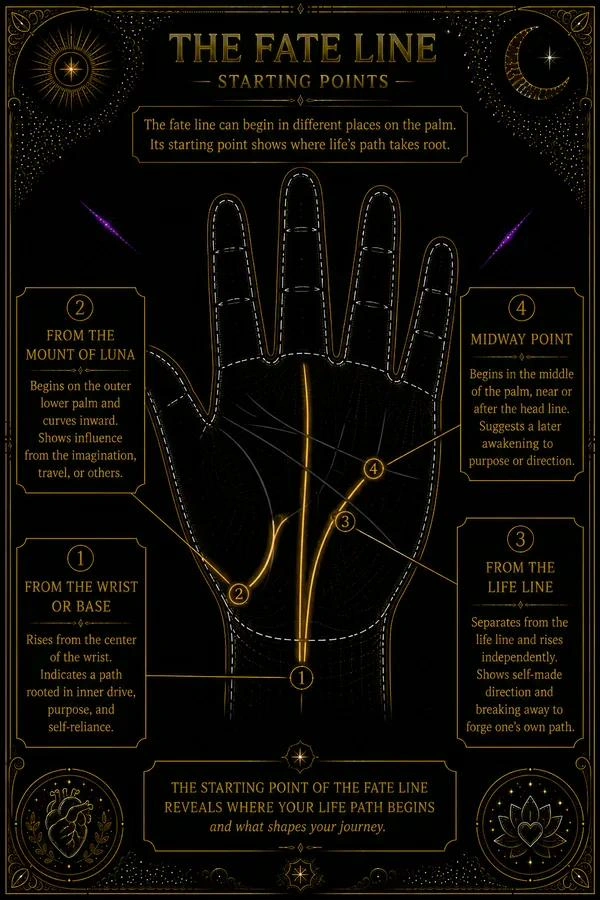
The starting point of the fate line is one of its most informative features. The line can begin in several different places, and each carries different associations. Look at the lower portion of your palm — the base — and find where the line begins, if it begins at all.
From the wrist or the base of the palm: When the fate line rises from low on the palm, near or at the wrist, it is traditionally associated with a life in which a sense of direction or vocation established itself early. Cheiro read this as the line of someone whose path is long and continuous — a consistent thread running from youth onward.
From the Mount of Luna: The Mount of Luna sits at the outer edge of the lower palm, opposite the thumb side. Benham wrote that when the fate line "rises from the Mount of Moon and runs on to the Mount of Saturn the subject's success in life will be materially assisted by one of the opposite sex." Contemporary readers have broadened this into a wider association with direction shaped significantly by other people — public life, collaboration, or work that depends on an audience — and West reads it as particularly common among those whose work brings them into sustained contact with others. That broader reading is a modern extension of Benham's point, not his own claim.
From the life line: When the fate line separates from the life line and rises independently from it, the association is with a direction that grows directly out of personal effort, or one that breaks free from the influence of family or early circumstances. Gettings reads this as a path that the subject builds themselves, emerging from the same source as their physical vitality before establishing its own course.
From within the palm — starting higher: When the line doesn't appear until midway up the palm — beginning near or after the head line — it is traditionally associated with a direction that clarifies or consolidates in the middle period of life. West and Fincham both note that late-starting fate lines are common in people who find their vocation or define their path through accumulated experience rather than early clarity.
The path: how it travels
Once you have located the starting point, follow the line upward. Observe how it travels toward the mount of Saturn at the base of the middle finger.
A line that rises straight and undeviating is traditionally associated with a consistent and focused direction — a path that holds its course without major deflection. Benham describes a clear, straight fate line as the mark of someone whose effort is well-directed and whose purpose does not scatter.
A line that curves or bends as it rises introduces more complexity. If the line inclines toward the Jupiter mount — toward the index finger side of the palm — the deviation is traditionally associated with ambition, a directional pull toward leadership or public achievement. If it inclines toward the Apollo mount — toward the ring finger side — the association shifts toward artistic or creative expression. These deviations are read as qualifiers, not corrections. They describe where the line's energy is drawn.
A fate line that runs directly alongside the life line for a portion of its ascent before separating carries a specific reading in Benham: it suggests a period of life in which personal freedom or independent direction was restricted — often by obligation to family or circumstance — before the line breaks free to its own course.
Depth and clarity
Now look at the quality of the line itself, applying the depth and clarity vocabulary from the first lesson.
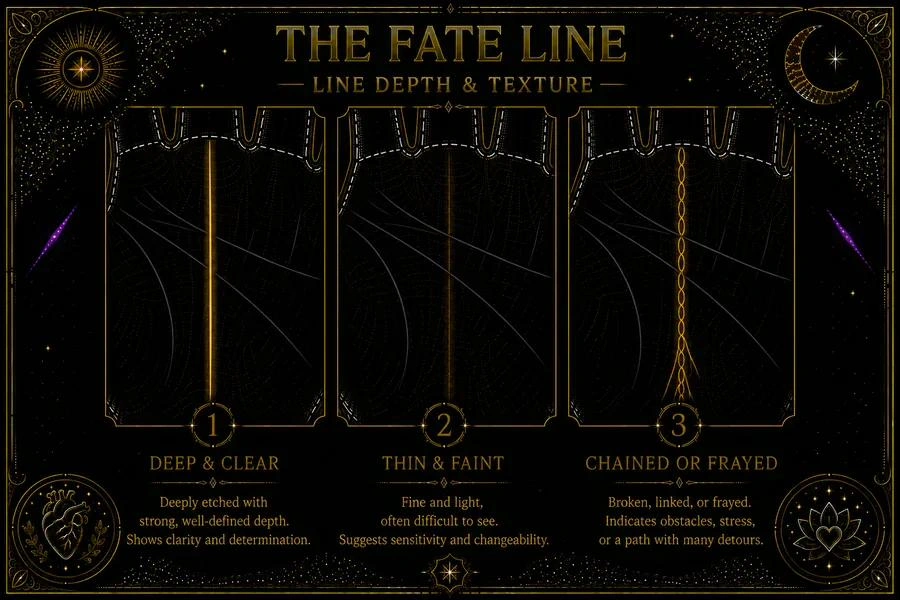
A deep, clearly formed fate line is traditionally associated with strong definition of direction — purpose that is established, consistent, and resilient. Cheiro reads a deeply marked fate line as the sign of someone whose career or life course is not easily disrupted by circumstance.
A faint fate line suggests a more fluid relationship with direction — not an absence of it, but one that is more tentative, changeable, or self-questioning. This is not inherently a weaker position. Fincham notes that a faint fate line can belong to someone who values freedom from rigid structure, or who lives in a way that resists reduction to a single defined path.
A chained or frayed section is associated with a period of uncertainty or disrupted direction at the point where it appears.
Where it ends: the endpoint
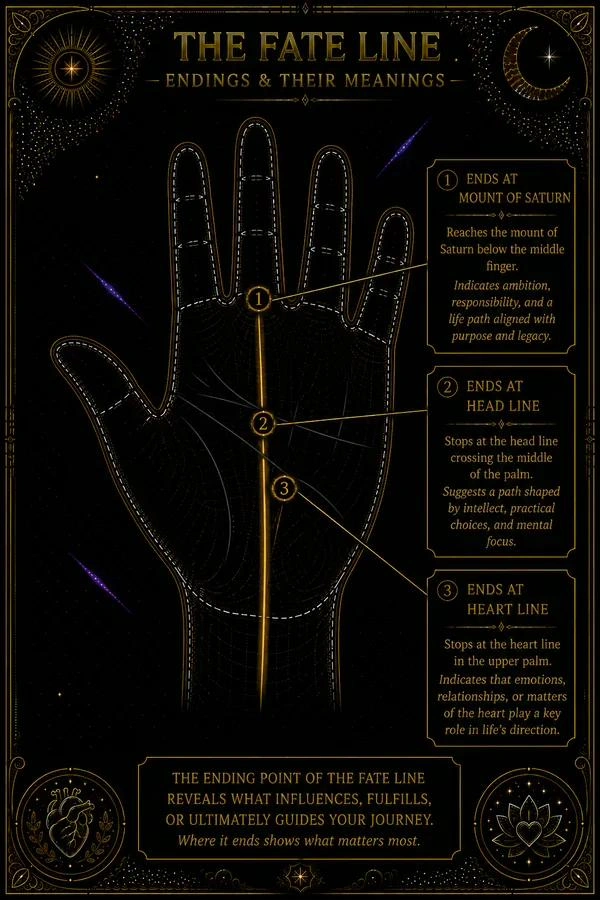
Follow the line to where it stops. Most fate lines end somewhere in the upper third of the palm, in the vicinity of the Saturn mount at the base of the middle finger. Some end earlier.
A fate line that reaches the Saturn mount — or approaches it closely — is the most straightforwardly read endpoint: a life direction that runs its full course. Gettings reads this as a path that sustains itself through life's arc without being significantly redirected.
When the line ends at or near the head line — the horizontal crease crossing the middle of the palm — the traditional association is with a change or interruption at the point in life represented by that zone: a moment at which direction is reassessed, redirected, or broken by a decision or significant event. West reads the head line endpoint as particularly associated with decisions — the line's course altered by a deliberate choice.
When the line ends at or near the heart line — the upper horizontal crease — the traditional association shifts to matters of relationship or feeling: a direction altered by an attachment, a commitment, or an emotional circumstance. The heart line represents where reason gives way to feeling in Cheiro's framework; a fate line that ends there is read in that context.
Breaks and changes of direction
A break in the fate line is traditionally associated with a significant change in life's direction at the point the gap appears. This is not read negatively by the established sources. Cheiro describes breaks in the fate line as markers of substantial change rather than of failure: a career shift, a fundamental reorganisation of life's course, a moment at which one trajectory ends and another begins.
An overlapping break is consistently read as a transition that is managed rather than abrupt: one path beginning to take shape before the previous has fully closed.
If the line resumes in a different position after the break — shifted toward Jupiter or Apollo, for instance — the new direction is read with the associations of wherever the line now travels. Direction changes are noted and read on their own terms — not treated as errors in the pattern, but as the pattern itself.
A fate line that consists of two or three distinct sections with gaps between them is simply a life of more than one defined chapter. Many readers find this feature more interesting than a single unbroken line.
Across the traditions
Indian palmistry names the fate line Shani Rekha — the line of Saturn, understood through the cosmological weight that Saturn carries in Vedic astrology: karma, discipline, obligation, and the relationship between present action and accumulated consequence. The Hasta Samudrika Shastra framework reads Shani Rekha within a system of planetary mounts that assigns each major line and mount to a celestial body. The fate line's associations with structure and direction are broadly comparable to the Western reading, though the philosophical frame — particularly around karma — gives it a distinctly different weight. In the Indian tradition, the line is less about vocation in the Western career sense and more about dharmic duty: the path a person is called to fulfill.
Chinese palmistry does not map directly onto the fate line concept in the same way. The vertical lines on the palm are often read differently within the Tian Di Ren framework, and forcing a direct correspondence muddies both systems. It is worth knowing that the Chinese tradition approaches these features through a different cosmological lens entirely.
Holding the observations together
You have several features to place alongside each other: whether the line is present at all, where it starts, how it travels (straight or inclining), how deep and clear it is, where it ends, and whether there are breaks or direction changes.
None of these is read in isolation. A faint fate line rising from Luna on a hand with a strong Apollo mount and a clear head line tells a different story than the same faint line on a hand where the other markers are also indistinct. The fate line is one thread in the reading.
Hold it lightly. The traditions that developed this system — Cheiro, Benham, Gettings, West, Fincham — were consistent on the point that the fate line describes tendencies of direction, not fixed outcomes. A strong line does not guarantee a clear path. A faint line or absent line does not mean the path is lost. The hand shows the configuration of the moment it is read, not the unalterable sentence of a life.
Practice
Look at your own hand now. What does the fate line — or its absence — add to what you have already read?
Lesson takeaway: The fate line is associated with the degree of structure and direction in a life — not with predetermined destiny. Absence is normal and carries no negative meaning. The line is read across five main variables: origin (where it starts), path (straight or inclining), depth and clarity, endpoint (which line it reaches), and any breaks or changes of direction. Each starting point carries different associations — from early-established direction to a path shaped by others to a vocation that consolidates mid-life. No single feature is read alone.
Checkpoint — The Major Lines
Work through these before moving on. If any of them leaves you unsure, go back to the lesson it draws on — there is no penalty for revisiting a lesson, and nothing here is a test you can fail.
-
Choose one major line on your own hand and describe it using only line-quality vocabulary — its depth, its clarity, and what it does along its course. Then say what you have deliberately not done.
Show a worked answer
You should have described depth (deep to faint), clarity (crisp to diffuse), and course (running clean, chained, or broken, and whether it forks, branches, or carries an island). What you have not done is interpret. Describing before interpreting is the entire point of learning that vocabulary first — it gives you something accurate to reason from instead of a meaning you reached for early.
-
Why is a line's depth always judged against the other lines on the same hand rather than against a fixed standard?
Show a worked answer
Because hands differ enormously in how heavily they are marked overall. A line that counts as deep on a finely-marked hand may be shallower in absolute terms than a faint line on a heavily-marked one. Depth and clarity are comparisons made within a single hand, which is why you assess all the lines before deciding any one of them is strong or weak.
-
Distinguish a fork from a branch, and both from an island — then say what makes an island different in kind from the other two.
Show a worked answer
A fork divides a line at its end. A branch leaves the line along its length. An island separates from the line, encloses a space, and rejoins it. The island is different in kind because it is the one that encloses — that closed space is what defines it. It is also the marking historical sources most often attached health meanings to, which is why this site reads it through context rather than assigning it a fixed meaning, and never delivers it as health information.
-
The hand in front of you has no fate line at all. What do you say?
Show a worked answer
That its absence is normal and carries no negative meaning. The fate line is the one major line genuinely not present on every hand, so a hand without one is unremarkable rather than deficient. It does not establish that the person lacks direction, purpose, or a future.
Notice what you should not do here: reach for a replacement meaning. There is no need to tell someone what an absent fate line signifies instead. It can simply be recorded as absent, and the reading proceeds from the features that are present. If you do report a specific interpretation of absence, it should be attributed to the source that makes it rather than offered as a general truth. It is also a good moment to say plainly that this line is read for tendencies of direction, not fixed outcomes.
-
A hand shows a deep, clear head line and a heart line that is chained across most of its length. Why is it a mistake to resolve that into a single tidy statement?
Show a worked answer
Because each is a clear, unambiguous observation, and the tradition reads the two in different directions. The honest reading names each one, anchored to what you can see, and leaves the tension standing rather than inventing a story that makes them agree. You will work on exactly this in the synthesis lesson later in the curriculum; for now it is enough to notice that a tidy answer here would claim more than the reading supports.