Hold your active hand palm-up and look at the horizontal lines crossing the upper part of your palm. In previous lessons you read the heart line — the crease running across the top of the palm — and the head line running beneath it, with a zone of palm clearly visible between them.
Now look again. Are those two lines there, distinct and separate? Or is there only one?
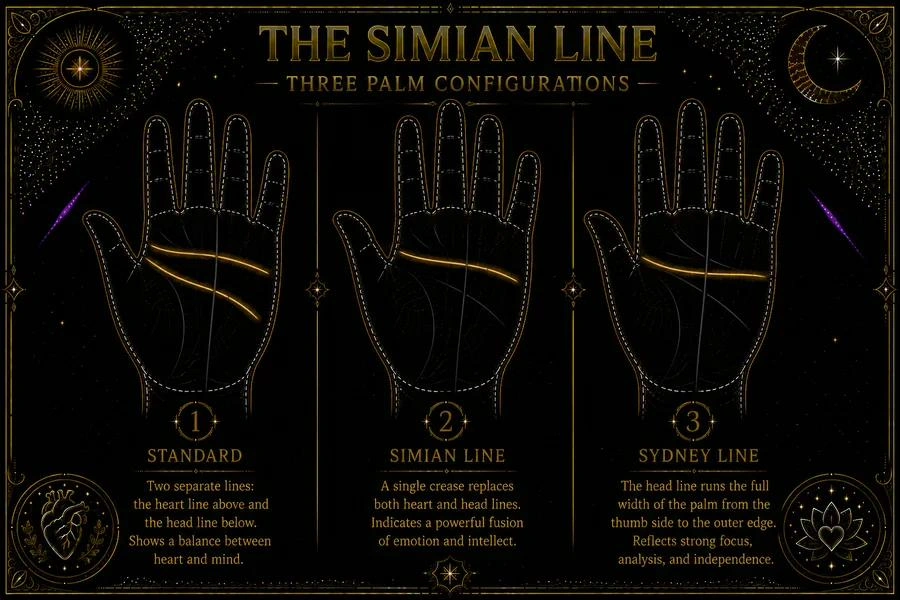
Three configurations — which is yours?
Most hands show the standard arrangement: the heart line running across the upper palm, and the head line below it, separated by a visible band of skin. These are two distinct features, and you have read them as such.
A small number of hands — roughly one to four percent — show something different. Where two lines would ordinarily run separately, there is a single horizontal crease crossing the full width of the palm. This is the simian line. Not two lines joined at an angle, not two lines close together, but one crease where two would ordinarily be. If that is what you see, this lesson is about you.
A third possibility sits between the two: the Sydney line. On a Sydney-line hand, the head line is present and clearly visible, but it extends unusually far across the palm — running from the thumb side all the way to the percussion edge (the outer edge below the little finger) without curving downward as it would normally. The Sydney line is its own feature: the head line is still the head line, still readable as such, but its unusual length changes the reading. If your head line runs the full width of your palm but you still have a separate heart line above it, you have a Sydney line, not a simian line.
A word on the medical literature
Before reading what the simian line means in palmistry, you should know that it also appears in medical literature. The single transverse palmar crease has been documented at elevated rates in certain chromosomal conditions, including trisomy 21. This is accurate, and it is a reasonable thing to want context on.
The context is this: the simian line appears in approximately one to four percent of the general population — people with no associated chromosomal condition and no clinical significance attached to the crease itself. It is one of many markers examined clinically, not a standalone indicator of anything. Its presence, without other clinical features, carries no diagnostic weight. If you have a simian line, the statistical likelihood is that you are part of the healthy minority for whom this is simply an anatomical variant.
The tradition’s reading of the simian line is a character reading — not a health reading. The two framings are separate, and conflating them serves neither.
What the simian line actually represents
The heart line is traditionally associated with emotional nature — the quality of feeling, depth of connection, how a person engages with others and with experience. The head line is traditionally associated with the thinking function — the character of reasoning, how mental energy moves and is applied.
When those two lines share one channel, the tradition does not read this as a blending — as though feeling had softened the thinking, or thinking had organised the feeling into something more orderly. The reading is a fusion: the two functions operate together, not alongside each other. What the person feels, they also think. What they think, they also feel. The separation that most people have — the ability to process an experience emotionally or intellectually, or to hold those two responses at some distance from each other — is not the natural mode for someone with a simian line.
The quality this produces, across the major sources, is described consistently. Cheiro, in Palmistry for All (1916), called it “tremendous intensity of character.” Benham, in The Laws of Scientific Hand Reading (1900), noted an unusual capacity for single-minded pursuit — the ability to direct the full weight of both emotional investment and intellectual focus toward whatever holds the person’s attention. Gettings, in The Book of the Hand (1965), held both sides of this observation together without resolving them: exceptional drive and tenacity on one hand, a quality of fixedness that makes stepping back or revising a position genuinely difficult on the other.
The core quality the tradition names is intensity of focus. Not volatility. Not instability. Not danger. Intensity — and with it, an all-or-nothing quality to engagement. When something claims the attention of a simian-line person, it tends to claim it fully. When it does not, the disengagement is equally complete.

The Sydney line: a related reading
If you identified your configuration as a Sydney line — head line present and extending the full width of the palm, with a normal heart line above it — you are reading a different feature with its own associations.
The Sydney line is traditionally associated with a thinking function that reaches further than usual into the emotional register. The head line’s extension toward the percussion side of the palm — territory normally governed by the heart line’s domain — is read as mental energy that draws heavily on intuition and feeling, or that processes experience through a long chain of association rather than arriving at conclusions quickly.
West, in The Complete Illustrated Guide to Palmistry (1998), notes that the extended head line is often found on hands belonging to people with strong abstract and imaginative thought — minds that range widely rather than focusing narrowly. The heart line above it remains its own reading, available in full. These two features are read together but not merged.
The Sydney line is not the simian line, and reading them interchangeably is a common mistake. Verify which configuration you have before proceeding.
Reading your simian line: what to look at
If you have confirmed a simian line, there are several features worth examining before forming a complete reading.
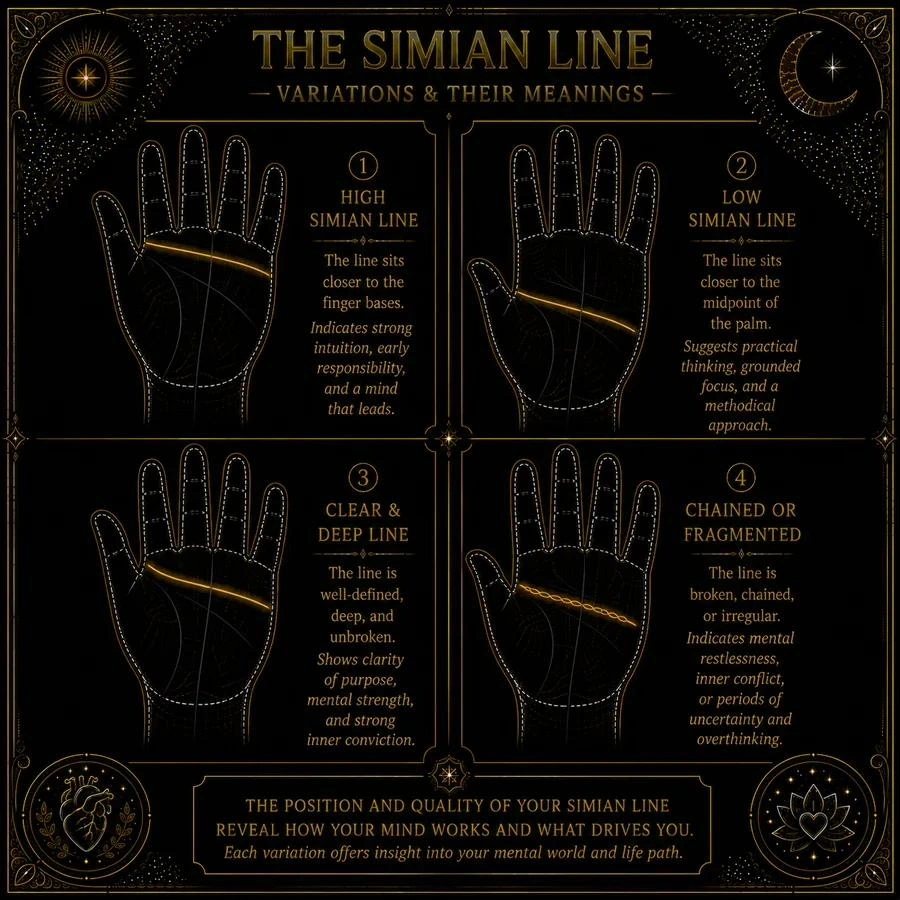
Placement: where does the crease sit? A simian line that runs high in the palm — closer to where the heart line would ordinarily be — carries more of the heart line’s character in the fusion: the emotional register is more prominent in how the fusion expresses. A line sitting lower, closer to where the head line runs, carries more of the thinking function’s character: the intellectual register leads. Neither is the better position. They describe the flavour of the fusion.
Depth and quality. A clearly defined, unbroken crease is associated with the pattern expressed consistently and with some force. A chained or fragmented crease — small interlocking loops rather than a clean channel — suggests variability: the intensity is present but less stable. A faint simian line indicates the same qualities in lesser degree. These are the same quality distinctions applied to all major lines in this module.
One hand or both. A simian line on the passive hand alone may suggest a constitutional disposition that the active hand’s development has partly moved away from. A bilateral simian line — the same configuration on both palms — is read as the pattern being fully constitutional and consistently expressed.
Partial configurations. Some hands show the lines fused in the centre of the palm but separating slightly toward one edge. This is read as a partial simian line: the fusion is present but incomplete. Some degree of independent operation in the emotional or intellectual register remains available, depending on where the separation appears.
The single-mindedness quality in practice
The tradition returns consistently to one quality in describing the simian line: focus that does not easily fragment. Benham’s description of tenacity — the capacity for sustained, single-minded pursuit — is the quality most consistently named across the sources. This is distinct from stubbornness, though it can shade into that depending on how it is expressed. The simian line indicates an orientation toward complete engagement: when the person commits, the commitment tends to be whole.
The difficulty side of this quality is noted with equal consistency. When feeling and thinking arrive together and reinforce each other, the resulting position is not easily revised. The emotional investment and the intellectual conviction are the same investment. What an ordinary separation allows — reconsidering an argument without it feeling like a personal defeat, or adjusting an emotional response once the facts shift — does not come as naturally to a simian-line person. This is what Gettings called the fixedness quality. It is not stubbornness in a moral sense. It is a structural feature of how the fusion operates.
Where the intensity is directed is what shapes the reading most. A person who channels this quality into sustained creative work, a long research project, or a demanding physical practice has a different experience of the simian line than one for whom it has no clear external direction. The simian line does not determine which of these situations applies. It describes the underlying resource — and the challenge.
The Indian tradition’s perspective
In Hasta Samudrika Shastra, this configuration carries the term ekaagra — single-pointed, undivided attention. The Sanskrit framing emphasises the same quality the Western sources name, but places it within a different context. Single-pointedness of mind is considered in the Vedic tradition both a hallmark of worldly effectiveness and a prerequisite for deep contemplative practice. The same disposition that drives exceptional concentration in the outer world is the disposition that extended meditation practice attempts to cultivate deliberately — treating as a destination what the simian-line person carries as a starting point.
The Indian reading does not view the simian line as a marker of difficulty or of special fortune. It is a constitutional observation: this person’s mind and heart operate as a unit. The consequences of that — whether it serves them well or creates friction — depend entirely on what the unit is directed toward.
Relationship implications as traditionally framed
The simian line’s relationship to emotional life follows directly from the fusion reading. Because feeling and thinking do not operate independently, the person’s emotional experience of close relationships tends to carry the same all-or-nothing quality as their engagement with everything else. Deep commitment when engaged; pronounced withdrawal when not. The capacity for great loyalty alongside the difficulty of partial investment: this person does not easily occupy the middle register.
Gettings notes that this can create intensity in close relationships that not every partner finds easy to sustain. West observes that the simian line’s quality of focused attachment — once formed — tends to be durable. The tradition does not read this as either romantic advantage or romantic liability. It reads it as a particular way of attaching: strongly and without much gradation. How that expresses depends on everything else in the hand.
What this lesson adds to your reading
If you have a simian line, you have now read the last of the major lines in a form that differs structurally from the others. The simian line is not a variant of the heart or head line reading — it replaces both with its own framework. The features you examine are different: placement, depth, quality, bilateral or unilateral expression.
If you have the standard configuration — two separate lines, clearly distinct — you have already read your heart and head lines in earlier lessons. The simian line does not apply to you, but recognising it when you see it on another hand is part of the practice.
And if you identified a Sydney line, you have a head line worth returning to with the extended-line reading in mind. It remains the head line — readable as such — but with a reach that the standard reading doesn’t fully account for.
The traditions that developed this system were consistent on one point: the simian line is a mark of character, not of fate. It describes how a person’s thinking and feeling relate to each other — which is substantial. It does not determine what becomes of either.
Lesson takeaway: The simian line forms when the heart and head lines fuse into a single crease, replacing the standard two-line configuration. It is found in roughly one to four percent of the population and carries no medical significance on its own. The core reading across Western and Indian traditions is intensity of focus: feeling and thinking operate as a unit rather than independently, producing strong single-mindedness, deep commitment, and a corresponding difficulty with partial engagement or easy revision. Placement (high or low) describes which register leads in the fusion. Quality (clear or chained) describes its consistency. The Sydney line — an extended head line, not a merged crease — is a distinct feature and should not be confused with the simian line.