Hold your active hand palm-up. Look at the left side of your palm — the thumb side. There is a curved line that begins somewhere between your thumb and index finger, sweeps in an arc around the base of the thumb, and descends toward the wrist. That is the life line.
Trace it now with a fingertip. Notice how it curves. Notice how much space it encloses around the base of your thumb. Follow it all the way to where it ends.
Before you go any further: if your line looks short, or broken, or faint, none of that means what popular palmistry says it means. That misconception is the first thing this lesson corrects — and it needs correcting before you can read anything else with a clear head.
The myth, corrected
Here the lesson has to separate two questions that are easy to run together: what the tradition historically claimed, and what Palmistry Path teaches you to do.
Historically, the classical writers did read the life line for length of life. Cheiro, in Palmistry for All (1916), states that the line "enables it to foretell the length of life from natural causes," associates a long clear line with "length of life, vitality, freedom from illness, and strength of constitution," and devotes a chapter to dating events along the hand by dividing the life line into seven-year periods. Benham, in The Laws of Scientific Hand Reading (1900), uses six-year divisions, reads a tasselled ending — where the line frays into several fine strands as it closes rather than finishing as one — as showing death at the age indicated, and reads islands as periods of delicacy and breaks as illness or accident — while warning that length of life "is a field that should seldom be approached at all, certainly not unless you are absolutely proficient, careful, and tactful."
Fincham, Gettings, and West broke with that, and Palmistry Path follows them. Johnny Fincham states flatly in The Spellbinding Power of Palmistry (2005) that a short life line does not mean a short life; Gettings and West read the same way. The reason to prefer the modern position is not that it is kinder — it is that the older claim has been tested, and the limited published studies covered in the life line article show a mixed record that does not establish a reliable relationship between the line and how long anyone lives.
So: you will meet lifespan readings in the older books, and you should recognise them for what they are rather than be surprised by them. You will not be taught to give one here.
Now you can read it clearly.
What the life line actually represents
Look again at the line's arc. Notice what it encircles: the fleshy, raised pad at the base of your thumb. That area is the Mount of Venus — associated in the Western tradition with physical warmth, the appetite for life, affectionate connection, and sensory vitality. The life line doesn't just run past the mount; it draws its boundary. The two are read together as a unit.
What the life line represents, across the major sources, is physical constitution — the underlying quality and rhythm of a person's bodily energy. Cheiro connects it to vitality and strength of constitution; Benham reads it as registering the health of the subject across the periods of a life. It also carries associations with major life transitions: points at which the shape or direction of a life shifts significantly.
What this lesson will not have you do is count years along the line. The older writers did exactly that, with formal dating schemes; this lesson does not teach them.
The arc: how wide does it sweep?
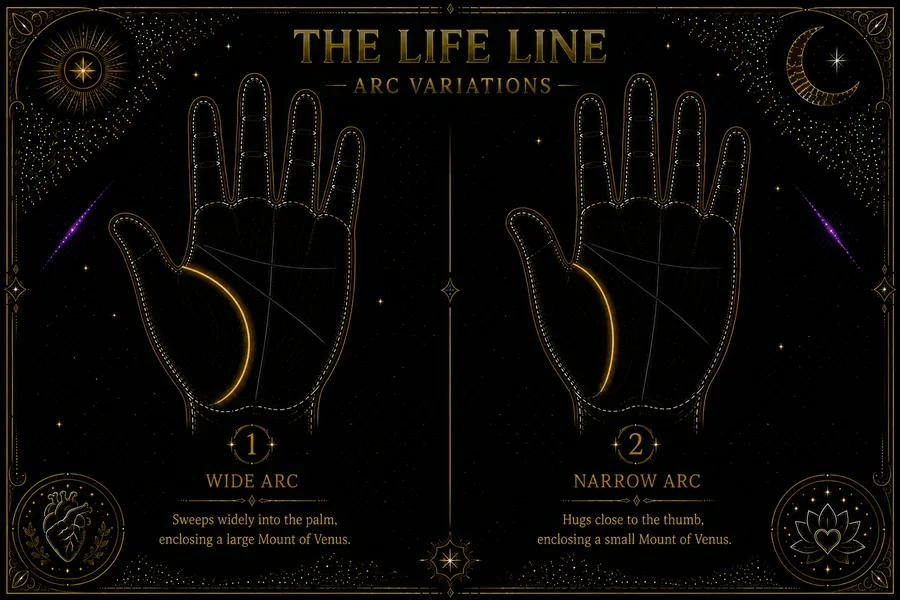
This is the most distinctive feature of the life line and the one to look at first. Place your active hand palm-up and observe: does the line sweep generously outward, carving a wide arc that gives the Mount of Venus plenty of room? Or does it run close to the thumb, keeping the arc narrow and the mount compressed?
A wide arc — one that crosses well into the palm before descending — is traditionally associated with expansive vitality: physical energy directed outward, warmth, enthusiasm for broad engagement with people and experience. The wide arc also produces a generous Mount of Venus, which amplifies those qualities. Benham and West both read a well-developed mount alongside a wide arc as a compound positive: the life force is strong, and it expresses itself outwardly.
A narrow arc — where the line hugs the thumb, leaving a smaller mount — is associated with more contained energy: a preference for a defined and private world, reserve in place of exuberance, energy that conserves rather than disperses. Benham noted that a narrow arc "reduces the size of the Mount of Venus, thus checking the operation of that Mount" — affecting the warmth and connective vitality that Venus governs. Neither wide nor narrow is a superior reading. They describe a quality, not a rank.
Depth and quality: look closely at the line itself
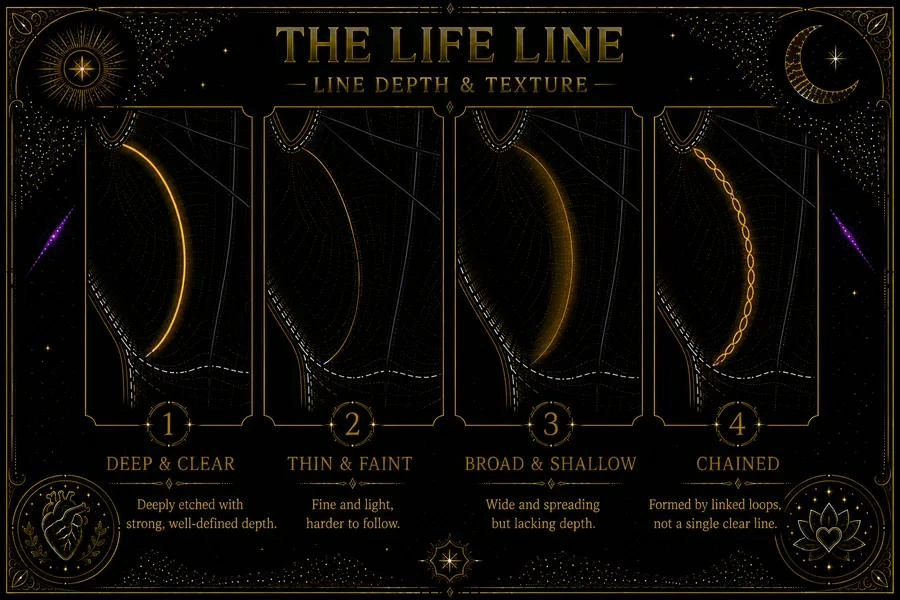
Now stop tracing the arc and look at the line's texture, applying the depth and clarity vocabulary from the first lesson.
A deep, clearly traced life line is associated with robust and concentrated physical constitution — the kind of vitality Benham described as "a strong, healthy fellow." The clarity of the crease is read as the clarity of the underlying energy: well-resourced, reliable, consistent.
A faint or thin life line does not signal absence of vitality but a different quality of it. Benham draws a careful distinction: the thin line suggests "nervous vitality" rather than "muscular vitality" — finer, more sensitive, less physically durable in sustained exertion, but not absent. He is precise that thinness does not mean the subject is "necessarily delicate or sickly."
A broad and shallow life line is the variation most associated with depleted or diffuse energy: vitality that covers ground without concentration or sustained reserves.
A chained section is traditionally associated with periods of fluctuating vitality or physical unsettlement.
Length: what it does and doesn't mean
Follow the line to its end. Does it descend the full length of the palm, reaching near the wrist? Does it stop partway down? Is it shorter than you expected?
A long life line — one that travels the full descent of the palm — is traditionally associated with sustained and abundant vitality: physical energy that persists without major interruption. This is the variation that produces the least interpretive complexity.
A short life line is where the myth does its most damage — and where this lesson needs to be direct. Palmistry Path reads a short life line, as an editorial choice, as a significant life transition or fundamental change of direction: a life that pivots substantially rather than running a single continuous course, with a particular quality of energy, intense and purposeful, but differently paced than a long line. Cheiro and Benham would have read the same feature partly in terms of duration and constitution; that older reading is the one this course sets aside, following Fincham, Gettings, and West rather than because the evidence above tested this specific interpretation — it tested lifespan length, not life transitions.
If your life line ends before reaching the lower palm, look at what surrounds it. Is there a sister line running parallel nearby? Do subsidiary lines continue in the area where the main line stops? These features are consistently read as qualifiers that maintain or redirect the energy the main line carries.
Length is read alongside quality, arc, and what the rest of the hand shows. A short, deep, clearly etched line on a firm hand with a strong Mount of Venus describes something very different from a short, faint, chained line on a narrow, weak hand. The number of centimetres is not the conclusion.
Branches and sister lines
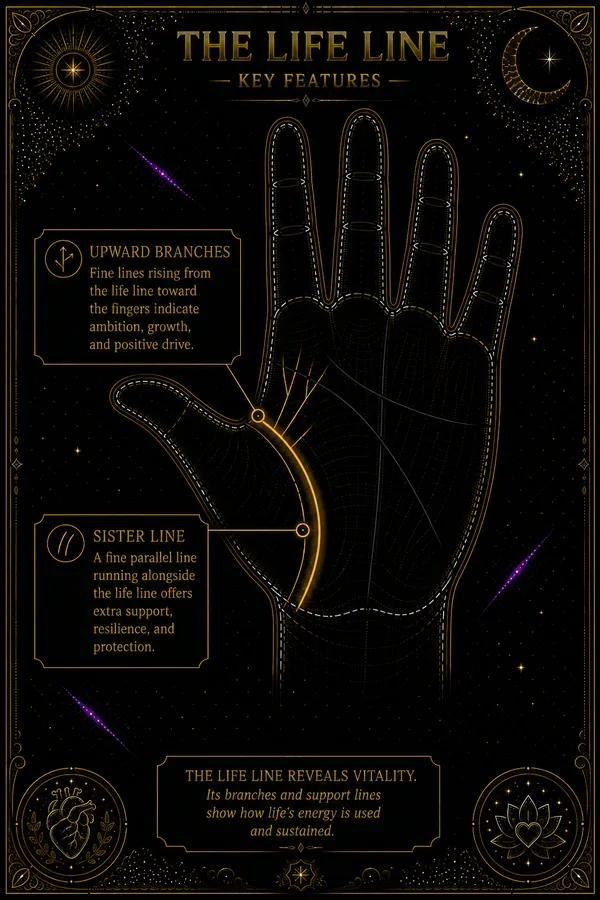
Look along the length of the life line for smaller lines rising from it or descending from it. Fine upward branches are traditionally associated with periods of upward movement — ambition, positive development, phases of renewed energy. Lines descending from the main course are associated with periods that draw on reserves: phases of strain, significant effort, or circumstances that deplete rather than replenish.
Now look for a parallel line running beside the life line on the Venus side. This is the sister line, also called the inner life line or Line of Mars. It is widely considered one of the more consistently positive markings on the hand. Benham says its "effect is to strengthen its sister line and to indicate a stronger constitution than is shown by even a deep Life line," and that where the life line is thin or chained it leaves "an underlying vital strength which will prevent the delicacy from taking any serious form" — a compensating thread of resilience where the primary line falters.
If you have a short or broken life line, check for this feature before drawing any conclusions from the main line alone.
Breaks: what the sources say, and what we do with them
A break in the life line is the variation that produces the most alarm, and the one where the classical and modern readings differ most.
In the classical texts, a break is a health reading. Benham treats it as an interruption to be diagnosed — most often illness, sometimes accident — assessed against the mounts and chance lines rather than on its own. Cheiro goes further, reading a broken life line as capable of indicating "great danger of death where the break appears", a danger he considers survivable where a strong line of Mars runs behind it. Both writers date the break to an age using their own divisions of the line.
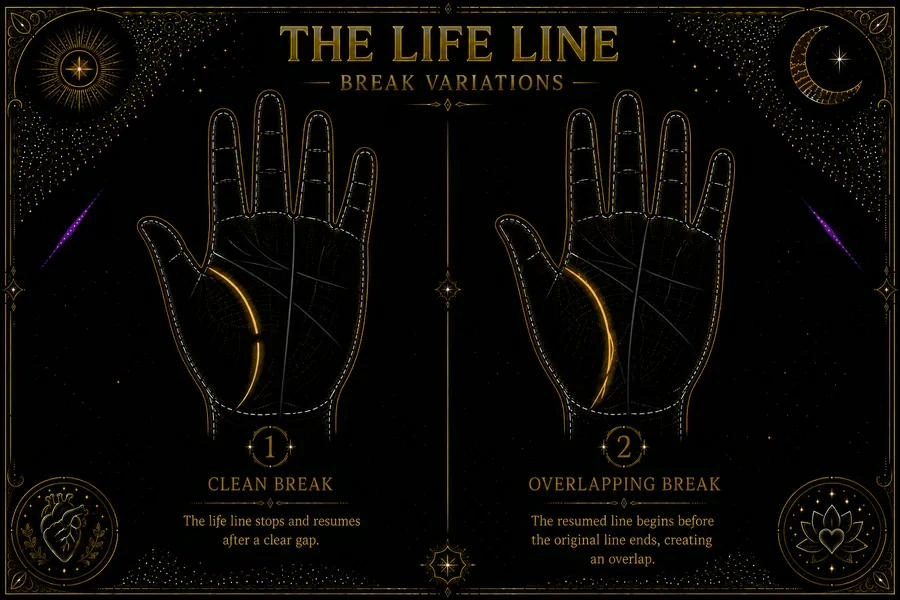
Palmistry Path reads a break as a transition, as an editorial choice. We read it as marking a major relocation, a fundamental shift in life's direction, or a point at which the shape of a life reorganises substantially — dropping the health and mortality reading entirely.
Palmistry Path does not use a break to predict illness, injury, or death. That is our editorial position rather than the tradition's. It is not a claim that research has tested and refuted the break-illness reading specifically — the published studies discussed in the life line article test line length against lifespan, not what a break marks. You should still recognise the classical reading when you meet it in the older books, because you will.
One refinement carries across both. An overlapping break is read as a smoother change than a clean break with a sharp gap. In the classical texts that bears on how serious the interruption is judged to be; here it describes how abruptly one phase of life gives way to the next. This course uses it only in the second sense.
Across the traditions
Contemporary Indian practice names the life line Jeevan Rekha and frames it in terms of prana, the animating energy that sustains the body. Note what that is and is not: modern Hindi terminology and a modern framing, not a classical Sanskrit designation. The older sāmudrika literature reads palm lines by shape and omen and names no life line at all, and it is openly predictive where it does read them — so the parallel here is with today's Indian practitioners, not with the classical texts. The similarity of method to the Western approach is part of why: much of what is taught under Indian names today has absorbed the Western scheme.
Contemporary Chinese palm reading names the life line the Earth line (Di) within the Tian Di Ren framework — the lowest of the three, below the Human line (head) and the Heaven line (heart), and associated with the physical and material ground on which a life rests. That is the vocabulary found across the contemporary Chinese palm-reading material we have consulted. Palmistry Path has not traced the three-line mapping to a specific classical text and claims no classical authority for it — nor, equally, that no such source exists. The conceptual weight differs from both Western and Indian readings, and forcing direct translation muddies all three.
Holding the observations together
You now have several variables to place alongside each other: the arc (wide or narrow, and what mount it frames), the depth and quality (deep, thin, broad and shallow, or chained), the length (full descent or shorter, and what surrounds the endpoint), any branches (rising or falling), the presence or absence of a sister line, and whether there are any breaks (clean or overlapping).
None of these is read alone.
A short life line on a hand where the arc is wide, the quality is deep and clean, the Mount of Venus is well-developed, and a sister line runs parallel to the shorter section is a very different reading from the same length on a hand where the arc is narrow, the line is faint and chained, and the mount is flat. Length is one variable among several, and it is not the most important one.
Practice
Look at your own hand now with all of this in mind. What does the life line add to what the heart and head lines already told you? What does it confirm? What does it complicate?
Lesson takeaway: The life line is read across five main variables — arc (wide or narrow), quality (deep, thin, broad and shallow, or chained), length (full or shorter), branches and sister lines, and any breaks. What you will read it for is the quality of physical constitution and vitality, and the character of major life transitions. What you will not read it for is the number of years a person will live. The classical writers did attempt that reading and built dating systems for it; the limited published studies that have directly tested it show a mixed record that does not establish a reliable relationship between line length and lifespan, and knowing both halves of that story — what the tradition claimed, and why we no longer claim it — is the point of this section.