Hold your active hand palm-up. Look at the horizontal creases across your palm. You've already found the heart line — the uppermost one. Now look just below it. There is another horizontal crease running across the middle of the palm, starting near where the thumb joins the hand and traveling toward the outer edge. That is the head line.
Before you go further, trace it slowly with a fingertip. Notice where it starts, which direction it travels, and where it ends.
Why Cheiro called it the most important line
Of all the marks on the hand, Cheiro — the Irish palmist whose system became the dominant reference in Western practice — considered the head line the single most important. His reasoning was direct: character shapes everything, and character is substantially a matter of mind. How a person thinks, reasons, concentrates, and approaches the world determines far more of their experience than the emotional or physical nature alone. The heart line may tell you how someone feels. The head line, in his view, tells you how they are.
That emphasis is not universal. Indian palmistry within Hasta Samudrika Shastra treats all three major lines as aspects of a single integrated reading rather than placing one above the others. Contemporary Chinese palm reading, within the Tian Di Ren framework, names the head line the Human line (Ren) — positioned between Heaven (heart) above and Earth (life) below — where its role is connecting rather than dominant. You'll carry Cheiro's framing as a useful frame throughout this lesson, while recognising that the traditions don't unanimously agree with it.
Origin: the joined start
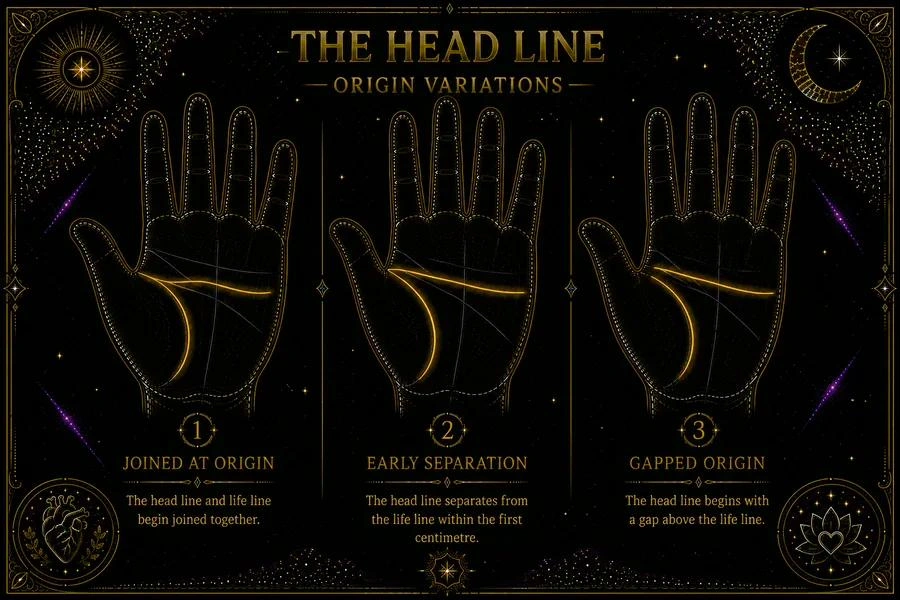
Look closely at where your head line begins relative to the life line. The two lines may emerge from the thumb-side edge of the palm together before separating and going their different ways, or they may begin apart from the start.
The extent to which the two lines are joined at their start — and how quickly they separate — carries traditional associations across Western texts.
A head line that starts joined to the life line and separates from it early, within the first centimetre or so, is associated with independence of thought: someone who forms their own conclusions relatively naturally, without sustained need for external reassurance before acting. A head line that stays joined to the life line for longer before separating is associated instead with caution and environmental sensitivity — not lack of capacity, but a tendency to look outward, to check the landscape, before committing to a course.
A head line that begins entirely separately from the life line — with a gap between them at the start — is traditionally associated with confidence and initiative, sometimes read as impulsiveness, sometimes as entrepreneurial directness. How to read it depends on what else the hand shows.
Path: straight or sloping
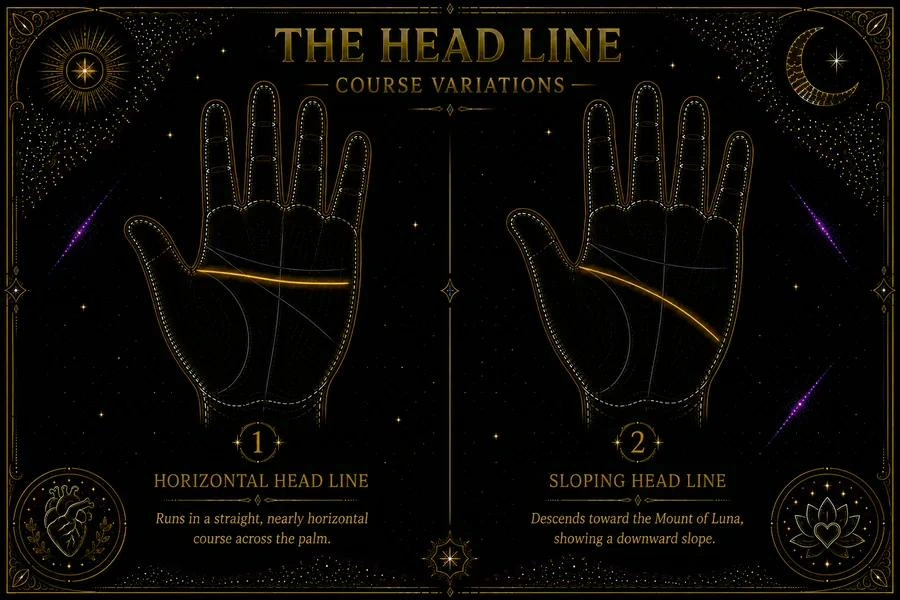
Follow your head line from its beginning toward the outer edge of the palm. As it travels, does it hold a roughly horizontal course — staying level as it crosses the palm — or does it slope downward, angling toward the base of the palm as it goes?
This is a clearly observable variable in the head line.
A head line that travels in a roughly straight, horizontal line is traditionally associated with practical and linear thinking: reasoning that stays grounded in observable fact, that favours the concrete over the abstract, and that tends to produce clear, workable conclusions. Benham, writing in 1900, described this as the mark of a mind that works efficiently within the real world as it is, rather than as it might be imagined.
A head line that slopes downward — descending toward the mount of Luna near the base of the outer palm — is traditionally associated with imaginative and creative thinking: a mind that generates connections, draws on intuition, and moves toward the abstract and the inventive. A strongly sloping head line reaching well down into the lunar zone of the palm is often read alongside creative or artistic inclination.
A head line does not have to match one extreme or the other — a moderate downward slope simply falls between the two, and the question becomes one of degree rather than which category the line belongs to.
Depth and clarity
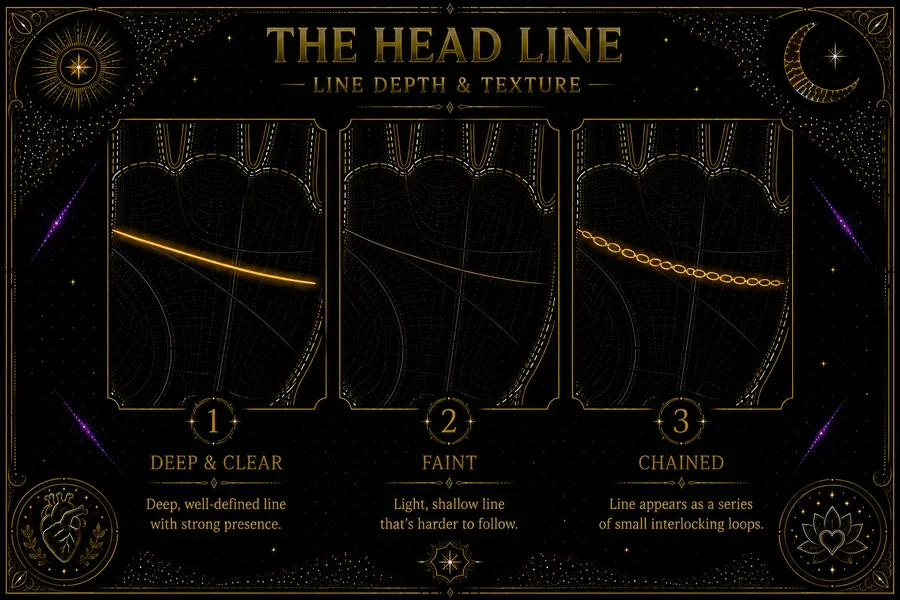
Look at the line itself now, not just its direction, applying the depth and clarity vocabulary from the first lesson against the other lines on the same hand.
A deep, clearly traced head line is traditionally associated with sustained concentration and strong mental focus: someone who can follow a line of thinking without losing the thread. A faint head line is often interpreted as more scattered or inconsistent mental energy — not low intelligence, but a mind that may find sustained focus more effortful, or that distributes itself across many interests rather than drilling into one.
A chained head line is traditionally associated with periods of mental difficulty, wavering concentration, or inner conflict.
Length: how far does it travel?
Follow the head line to its end. Does it cross the full width of the palm, reaching well into the outer half? Does it stop somewhere in the middle? Or is it shorter still — ending noticeably earlier across the palm than a line that reaches into the outer half?
A long head line — one that extends well across the palm toward or into the outer half — is traditionally associated with broad mental range: a mind that reaches across subjects, holds complexity, and maintains sustained intellectual engagement. Benham treats significant length this way, framing it as a positive quality tied to abundant mentality.
A short head line does not, on its own, indicate limited intelligence. Benham and Gettings both read a shorter line as indicating a more focused, direct, and efficient mental approach: less range, but more concentration, a mind that selects and commits rather than ranging widely. It is a different style of thinking rather than a deficiency of it.
The endpoint: where does it finish?
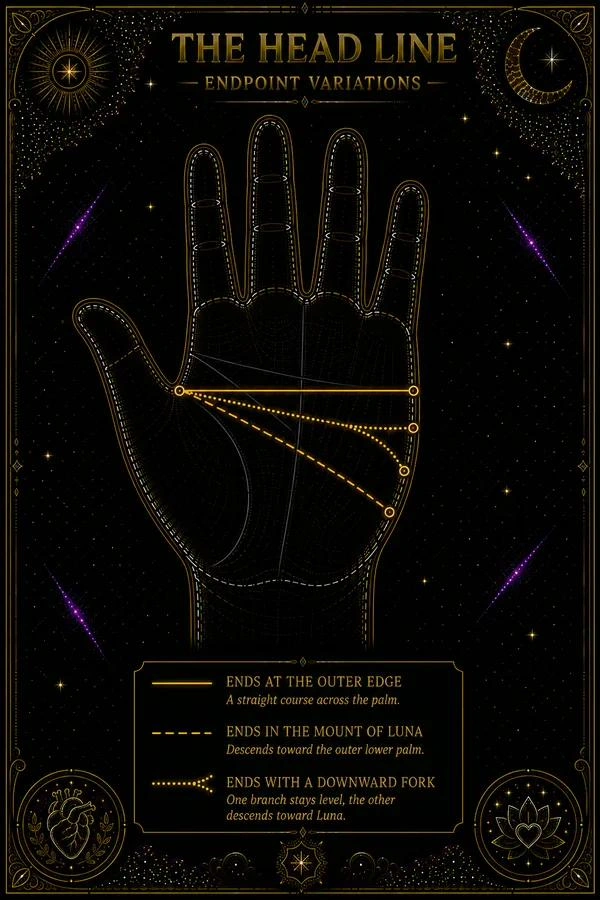
Look at where your head line comes to its terminus. A few specific endpoints carry particular traditional associations.
A head line that runs straight across and ends in the outer palm, roughly level with its starting height, is associated with the linear, practical quality already described — a mind that stays grounded in the concrete.
A head line that descends and ends in the mount of Luna — the rounded fleshy zone at the base of the outer palm — is associated with imaginative and intuitive mental life.
A head line that ends with a downward fork — one branch staying level, one dropping toward Luna — is traditionally associated with versatility: a mind that can work in both registers, moving between practical analysis and imaginative projection without getting stuck in either. This forked ending is traditionally read as a positive marking, discussed further below as the "writer's fork."
The writer's fork
One specific fork variant appears often enough in the literature to deserve its own note. When the head line ends in a pronounced fork — one branch descending clearly toward Luna while the other continues level — this marking has historically been called the "writer's fork" in the popular Western tradition. It is associated with the capacity to observe the world with practical clarity while simultaneously interpreting it through an imaginative register: the combination, in shorthand, of the reporter and the storyteller.
The name is informal and the association is with a mental quality rather than a profession. Someone with this marking is not necessarily a writer. But it does appear in the literature with enough consistency across the major sources — Cheiro, Gettings, West — to be worth naming.
Branches and breaks
Look along the length of the head line for branches rising or falling from it, and for any breaks.
Fine upward branches are traditionally associated with periods of mental ambition or intellectual effort: moments when the mind is reaching. Downward branches have been read as periods of mental strain or worry — times when the quality of thinking is under pressure rather than freely extending.
A break in the head line is traditionally associated with a significant change in mental direction: a shift in thinking, a disruption in outlook, or a period when previous patterns of reasoning were interrupted and reformed. Whether this is read positively or negatively depends on what surrounds it. A break followed by a strong resumption of the line is generally read more favourably than a break followed by a chained or faint line.
Across the traditions
Indian palmistry names the head line Matri Rekha or Shira Rekha depending on the source, and associates it with intellect, concentration, and the quality of thought more broadly. The structural approach — reading path, length, depth, and terminus — is closely parallel to the Western method. Where Indian readings diverge is in their placement of the head line within a broader picture of mental and spiritual constitution that includes mounts and secondary lines that the Western system addresses differently. The core of what you are learning here is shared.
In contemporary Chinese palm reading, the head line as the Human line (Ren) is associated with mind and will — the mediating dimension between Heaven above and Earth below within the Tian Di Ren structure. The interpretive approach differs substantially from both Western and Indian methods, and forcing direct comparison produces more confusion than clarity. It is enough to note that the same physical feature carries different conceptual weight depending on which tradition you're reading within.
Holding the observations together
You now have several variables: the origin (joined to the life line or separate, and how quickly they part), the path (straight or sloping, and to what degree), the depth and clarity (deep, faint, or chained), the length (how far it travels), the endpoint (where it finishes and at what height), and any forks or branches.
As with the heart line, none of these are read in isolation.
A steeply sloping head line on a hand where the heart line is also expressive and curved describes a very different person than the same head line on a hand where the heart line is straight and measured. A short head line on a broad, firm hand with deep, clean lines throughout reads differently than the same length on a hand where most lines are faint and fragmented.
Practice
Look at your hand as a whole. What does the head line add to what you already know from the heart line? What does it modify or confirm?
Lesson takeaway: The head line is read across six variables — origin (how it starts in relation to the life line), path (straight or sloping, and how steeply), depth and clarity (deep, faint, or chained), length (how far it travels), endpoint (where it finishes, including whether it forks), and any branches or breaks along its length. Cheiro's claim that it is the single most important line reflects the Western tradition's emphasis on character and mind — though Indian and Chinese palmistry frame its significance differently. In the next lesson you'll turn to the life line: the third of the three major lines.