Hold your active hand palm-up in front of you. You located the heart line in the previous lesson — find it again now. It's the uppermost horizontal crease on your palm, the one running across the hand closest to where the fingers attach. Trace it slowly with a fingertip, from one edge of the palm to the other.
That line is what this entire lesson is about.
The heart line is traditionally associated with emotional life — how a person connects, feels, and relates — and it tends to be the first line beginners want to interpret. That urgency is worth noticing: it can push you toward a single reading before you've actually observed what the line is doing. This lesson slows that down. You'll look at each variable in turn — path, depth, length, endpoint, branches — and hold them together at the end rather than jumping to a conclusion from one feature alone.
Where the heart line begins
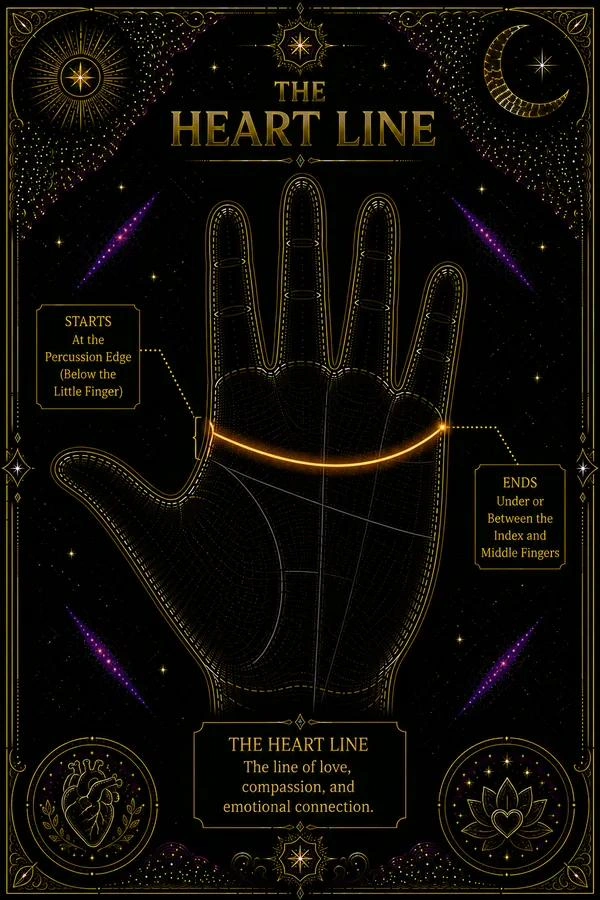
Look at the outer edge of your palm — the side beneath the little finger. The heart line almost always originates here, at what palmists call the percussion edge of the hand. From that starting point it sweeps inward across the upper palm, traveling toward the thumb side.
That origin is relatively consistent from hand to hand. What changes considerably is where the line ends. You'll focus on that shortly, but for now trace the line from its beginning and follow it across the palm. Some heart lines run a clean, uninterrupted course. Others are interrupted, textured, or split partway. Whatever you find, keep observing rather than evaluating.
Curve or straight: the line's path
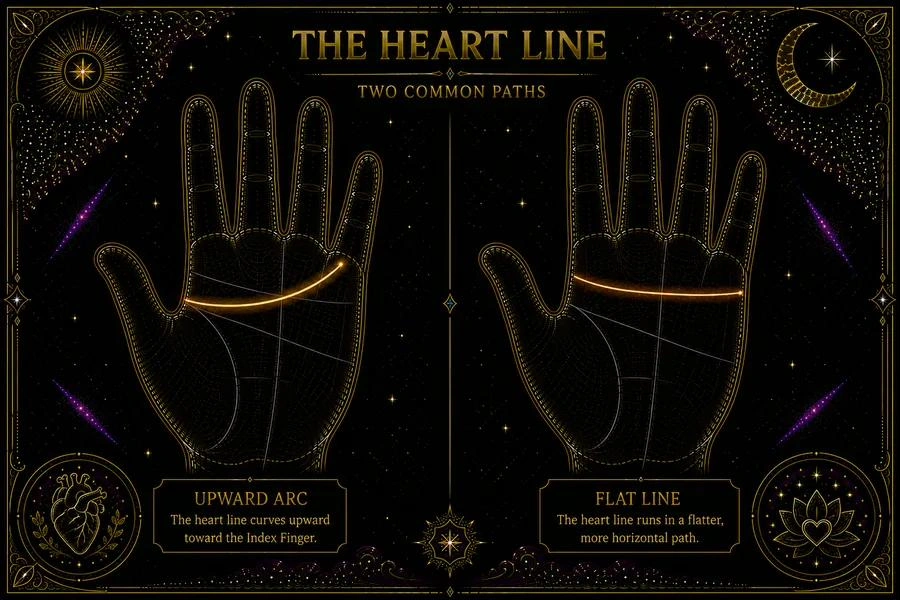
As your heart line travels across the palm, watch what it does. Does it arc upward toward the base of the fingers as it goes? Or does it run in a relatively flat, level course?
Most heart lines curve to some degree. The question is how much.
A line that rises clearly as it travels — developing a visible arc toward the fingers — is traditionally associated with expressive emotional nature: someone whose feelings find their way outward through warmth, gesture, and direct demonstration. A line that stays relatively level, without rising significantly, is more often interpreted as suggesting emotion that runs inward first — processed through thought or language rather than spontaneous outward display.
This distinction comes up repeatedly in the tradition and is worth pinning down on your own hand before moving on. Look again: does the line rise toward the fingers as it goes, or does it stay roughly horizontal?
Depth and clarity
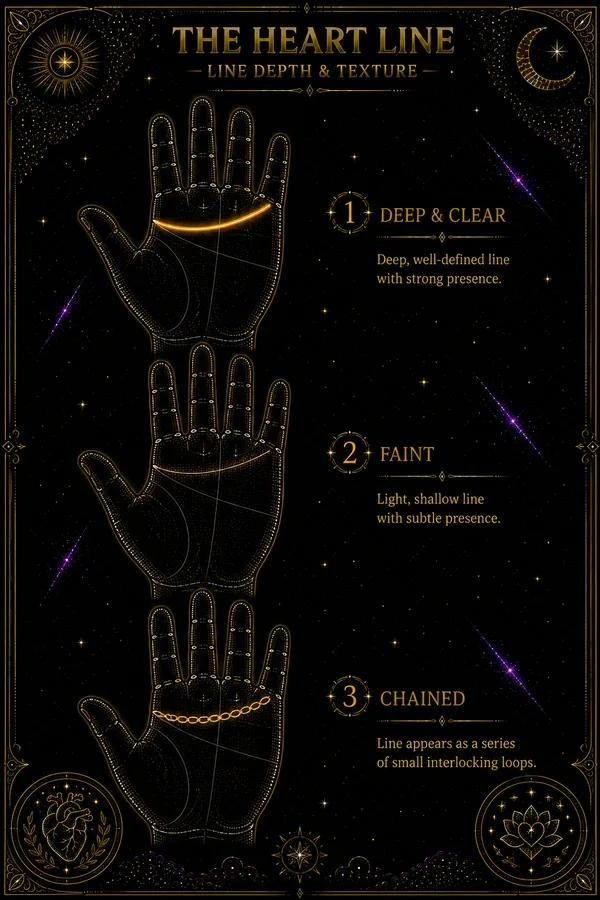
Now look at the line itself rather than its direction, and apply the depth and clarity vocabulary from the first lesson — judging what you see against the other lines on the same hand.
A deep, clearly traced heart line is traditionally associated with consistency and intensity in emotional expression: feelings that run strong and tend to be stable. A faint line is often interpreted as more moderated expression — not absence of feeling, but feeling held more quietly, expressed with less force.
Where the line runs chained, it is traditionally associated with emotional sensitivity and inner complexity: feelings that are genuine but not easily simplified, or a period in which emotional expression is particularly difficult.
Length
Look at how far your heart line travels across the palm. Does it extend well into the territory below the index finger? Does it stop near the middle of the palm? Does it end closer to the outer edge than to the thumb side?
A longer line — one that extends well across the palm — is traditionally associated with broad and sustained emotional engagement: someone for whom feeling and connection are significant and consistent features of experience. A shorter line, one that ends before reaching the midpoint of the palm, is sometimes described in popular palmistry as indicating limited emotional capacity. The more careful traditional reading, found consistently across Western sources, is that a shorter line may suggest focused investment rather than limited feeling — fewer connections, but not necessarily shallower ones. The inference that short equals cold is a simplification the classical texts don't support.
The endpoint: where does the line finish?
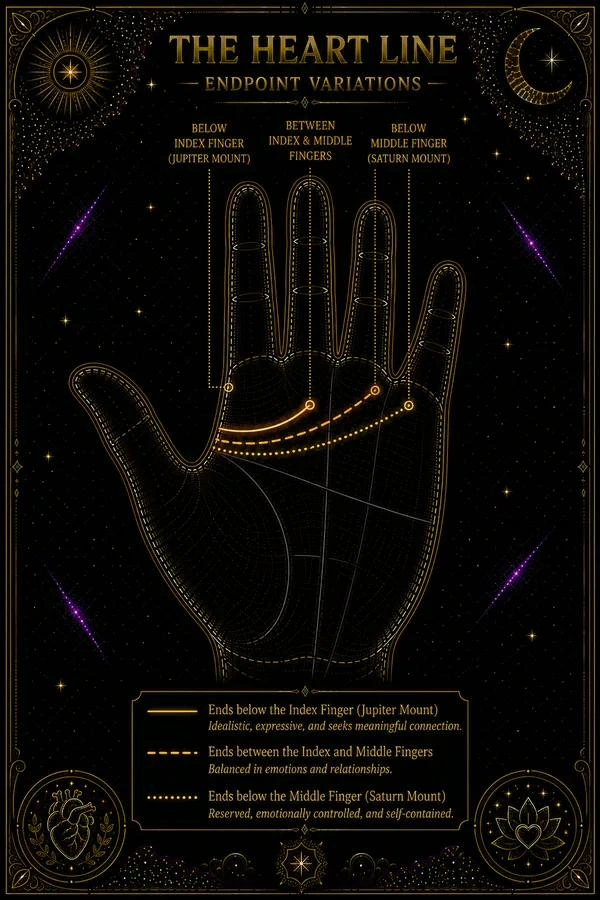
This is the most widely studied variable in the Western heart line tradition, and the one you'll encounter most often in the classical sources. Look at where your heart line ends. Follow the line to its terminus and identify what's below it: which finger's base is it closest to?
Three main positions carry distinct traditional associations.
Ending below the index finger, under the mount of Jupiter: A line that reaches the territory directly beneath the index finger is traditionally associated with idealism and depth in emotional commitment — someone with high standards for what relationships can be, who invests sincerely and substantially in those they love. Most Western sources treat this endpoint favourably.
Ending between the index and middle fingers, between Jupiter and Saturn: This intermediate position is widely described in Western texts as the most balanced — combining emotional depth with proportion, and idealism with enough self-possession to maintain perspective. Cheiro described this placement as reflecting genuine affection alongside a capacity to keep one's footing within it.
Ending below the middle finger, under the mount of Saturn: This position is where the traditions diverge most clearly, and it is worth knowing both readings. The Western tradition — Cheiro among the sources who discuss it — has generally associated this endpoint with reserve: a tendency to hold emotional life more privately, to receive love with more caution than one extends it. The Indian Vedic tradition reads this position differently, associating it with sthir bhava — stable, grounded emotional nature — emphasising reliability and long-term fidelity rather than restriction. These are not simply opposing conclusions about the same marking. They may be observing the same temperamental quality from different evaluative standpoints. Both are worth holding rather than resolving prematurely.
Forks and branches
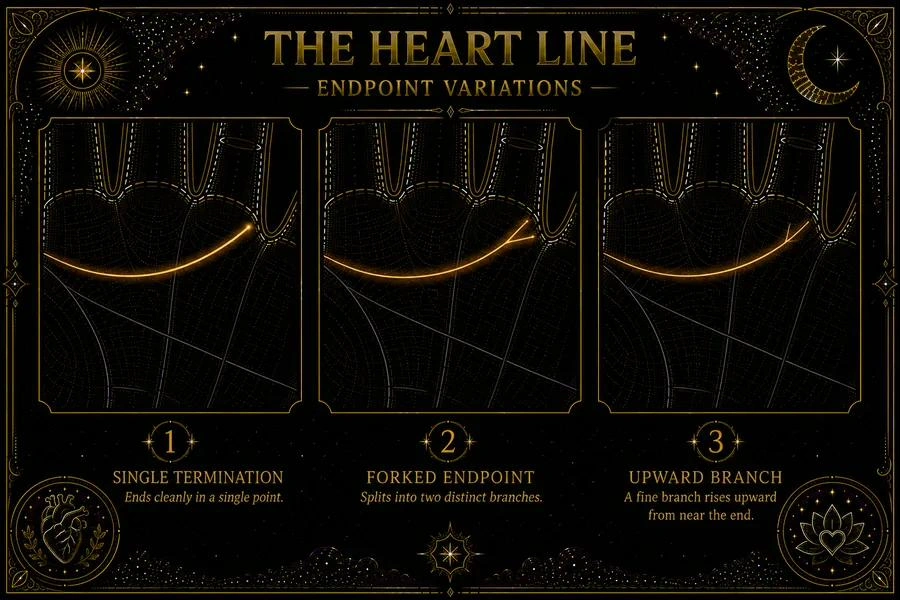
Look closely at the far end of your heart line. Does it arrive at a single point, or does it fork as it approaches its terminus? Small forks are easy to miss.
A forked endpoint is traditionally associated in Western palmistry with the capacity to hold emotional depth alongside practical perspective: someone who feels strongly without entirely losing their footing in the feeling. This is among the more consistent positive readings attached to a specific heart line marking in the Western texts.
Upward branches are traditionally associated with emotional aspiration, with the mount toward which the branch rises suggesting the quality that most draws the person's affections. Downward branches have been read as indicating moments when rational pressure is exerting itself against an emotional response — the head in conflict with the heart at a particular period.
Across the traditions
In Indian palmistry, within the Hasta Samudrika Shastra tradition, the heart line is called Hridaya Rekha and is associated with bhava — emotional nature understood broadly — alongside the capacities for sneha (affection) and prema (love). The approach to reading the line's path and quality is structurally similar to the Western one. Where they diverge — as at the Saturn endpoint above — both readings deserve attention rather than a forced synthesis.
In Chinese palmistry, the heart line corresponds to the Heaven line within the Tian Di Ren framework introduced in the previous lesson. The cosmological framing is different; the physical line is the same one you traced at the start of this lesson.
Holding the observations together
You now have a set of observations: the curve or straightness of the line's path, its depth and clarity, its length, where it ends, and whether it forks or branches. None of these are read alone.
A long, clearly traced line ending below Jupiter reads differently on a hand with a well-developed mount of Venus than on one where that mount is flat. A forked endpoint on a chained line tells a different story than the same fork on a deep, clean one. A straight heart line on a hand with a steeply curving head line sits within a different picture than the same line on a more balanced hand.
Hold what you've observed as tendency, not verdict. The tradition is consistent on this: individual features are starting points, and the hand is a system. What the heart line suggests only fully emerges in context.
Practice
Describe your own heart line across the five variables this lesson covered: path (curved or straight), depth and clarity, length, endpoint, and any forks or branches. Write each down in a phrase or two — description only, no interpretation. If a meaning suggests itself as you go, set it aside and keep describing.
Lesson takeaway: The heart line is read across five main variables — path (curved or straight), depth and clarity (deep, faint, or chained), length (how far it travels across the palm), endpoint (below Jupiter, between Jupiter and Saturn, or below Saturn, with Western and Indian traditions diverging on that last position), and any forks or branches at its terminus. None of these are read in isolation. The next lesson covers the head line — which runs just below the heart line, shares its origins with the life line, and which Cheiro considered the single most important mark on the hand.