Hold your active hand out in front of you, palm facing up. Let it rest naturally — don't flatten it or force it open. You'll see a series of lines crossing the surface: some deep, some faint, some running horizontally, some arcing or cutting diagonally across the palm.
Most people have noticed these lines. Few have learned to find them deliberately.
The previous lesson gave you the vocabulary for describing what a crease is doing. This one is about location: before you study what any line is traditionally associated with, you need to be able to find it reliably — to point to it, name it, and distinguish it from the lines beside it. That is the whole work here. Interpretation comes later, line by line, in the lessons that follow.
What palm lines actually are
Palm lines are skin creases — formed by how the hand folds and flexes during development in the womb and refined over years of use. They're structural before they're symbolic. The reason palmistry traditions developed frameworks around them is that they're consistent enough, across enough people, to be worth mapping: almost everyone has a heart line and a head line. Almost everyone has a life line. The fate line is a different story, and we'll come to that.
Knowing that lines are skin flexion creases doesn't diminish anything. It just means the starting point is observation, which is where palmistry always should start.
The four major lines
Western palmistry identifies four major lines. Three of them appear on nearly every hand. The fourth — the fate line — is common but not universal, and its absence carries no particular meaning.
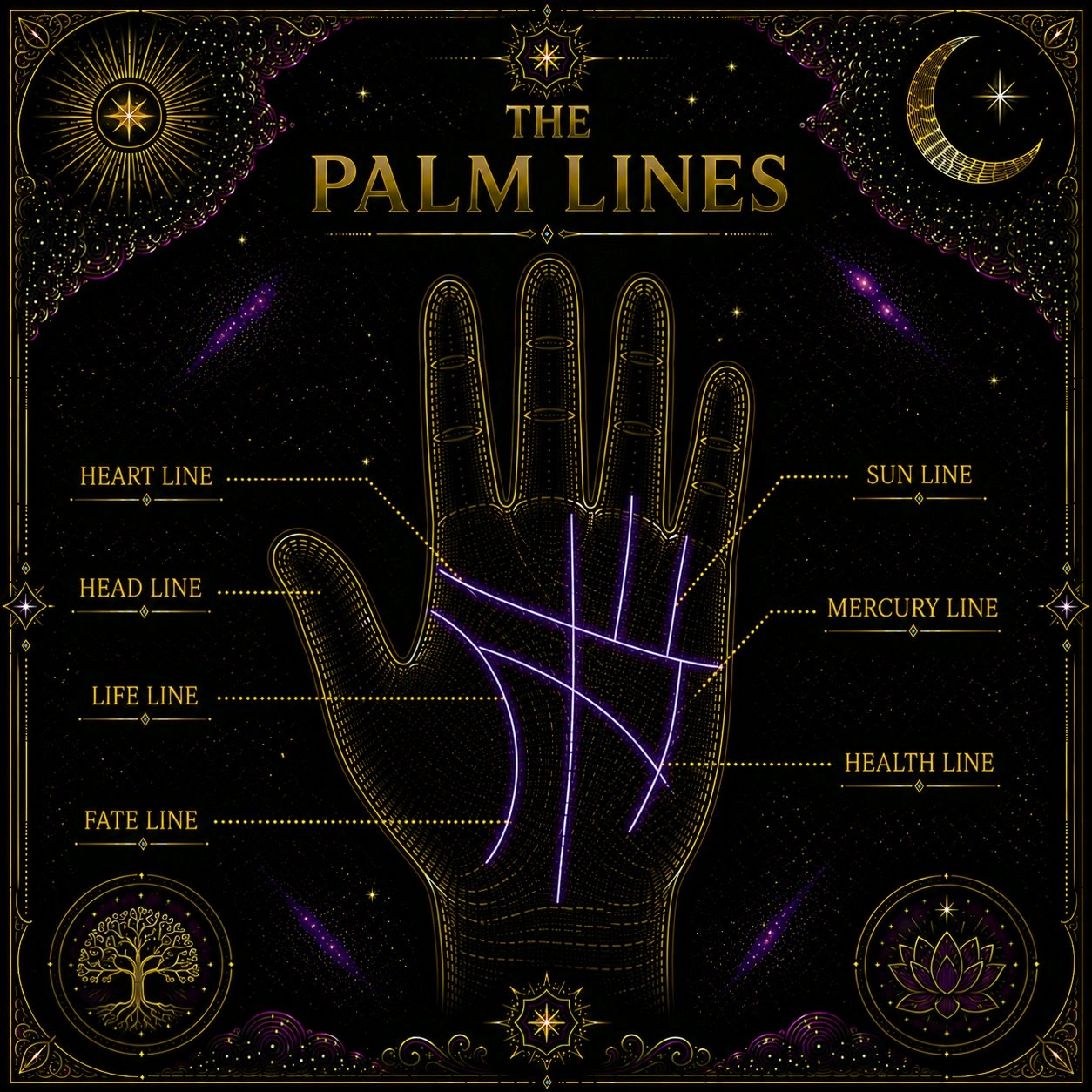
The heart line
Run your eyes across the upper portion of your palm, just below where your fingers meet the hand. You'll see a horizontal line — or what reads as roughly horizontal — that travels across the width of the palm. It may curve upward slightly toward the index or middle finger. It may end cleanly or branch into forks. This is the heart line.
It sits higher on the palm than any other major line. When you're uncertain which line you're looking at, the heart line is the one closest to the fingers.
In palmistry, the heart line is traditionally associated with the emotional life — how a person relates, feels, and connects. But you are not reading it yet. For now, find it and trace its path from one side of the palm to the other.
The head line
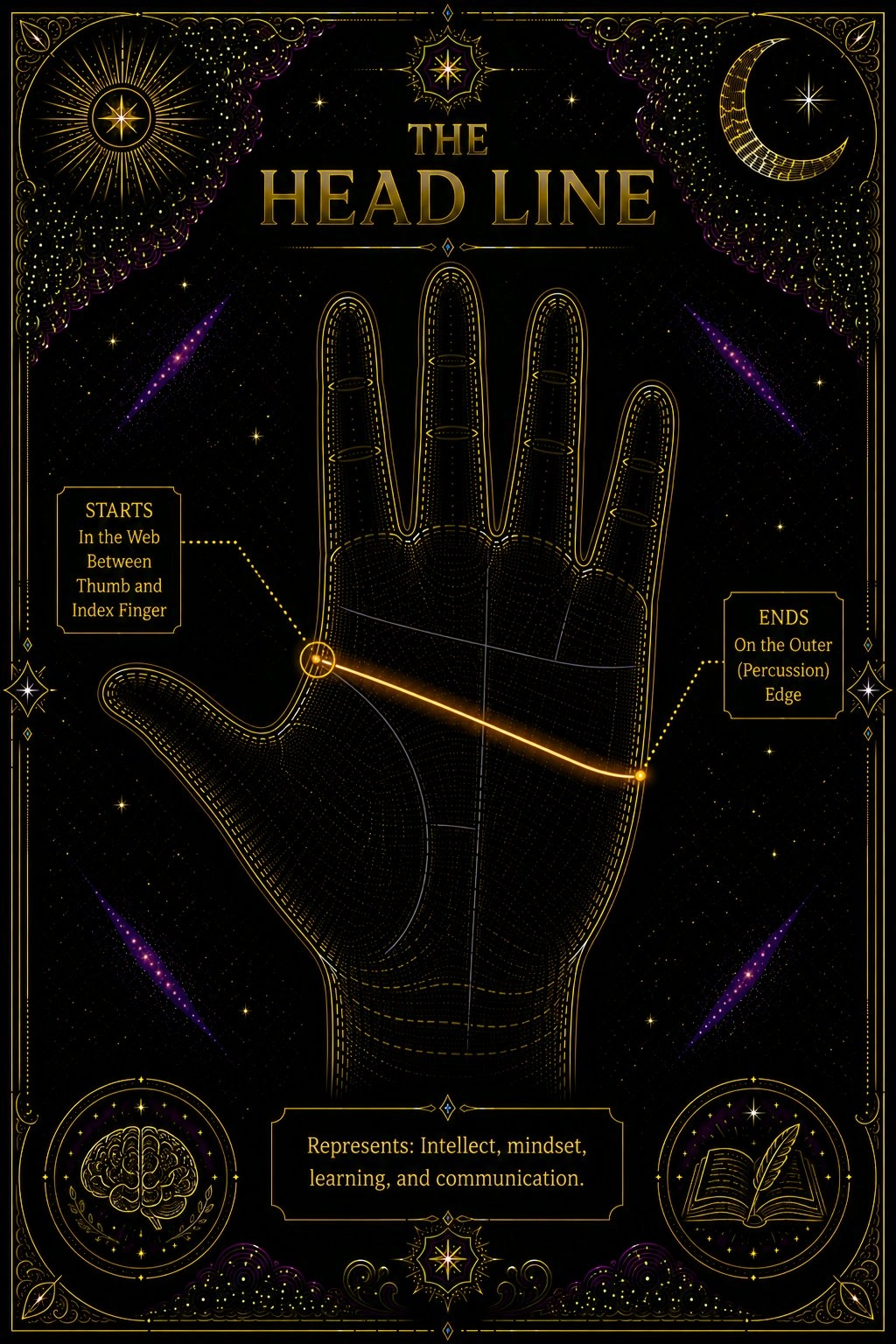
Below the heart line, running roughly parallel to it but lower on the palm, you'll find the head line. It typically starts from the same area where the life line begins — near the web of skin between your thumb and index finger — and travels across the palm toward the outer edge.
The head line and the heart line are often the two clearest horizontal lines on the palm. If you hold your hand up and squint slightly, you'll see them as a pair. Some people have a third, faint horizontal crease above the heart line near the finger bases. That's not a major line; it's a proximal transverse crease and you can ignore it here.
The head line is traditionally associated with how a person thinks — patterns of reasoning, focus, and mental approach. Again: find it first. Trace it. Learn its path.
The life line
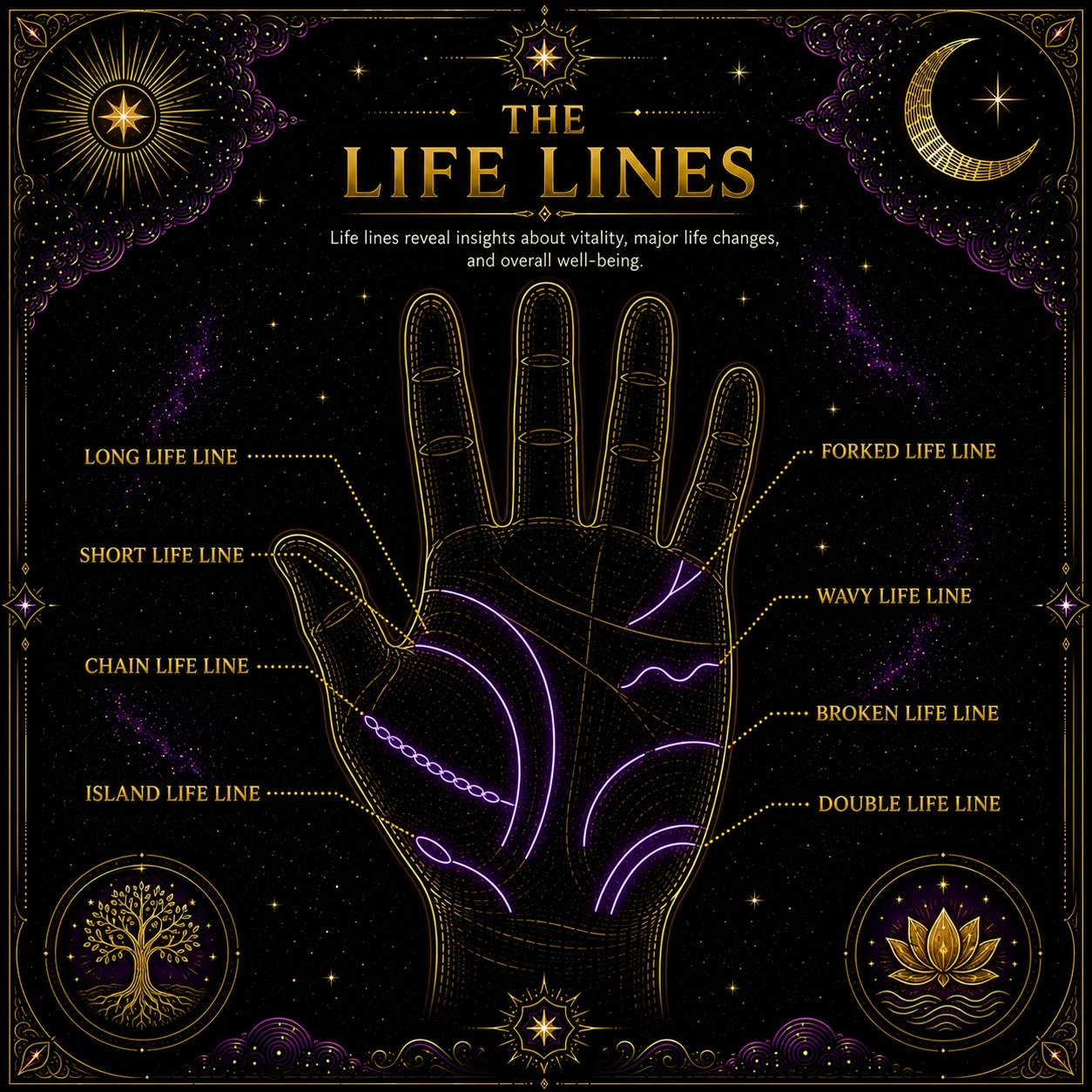
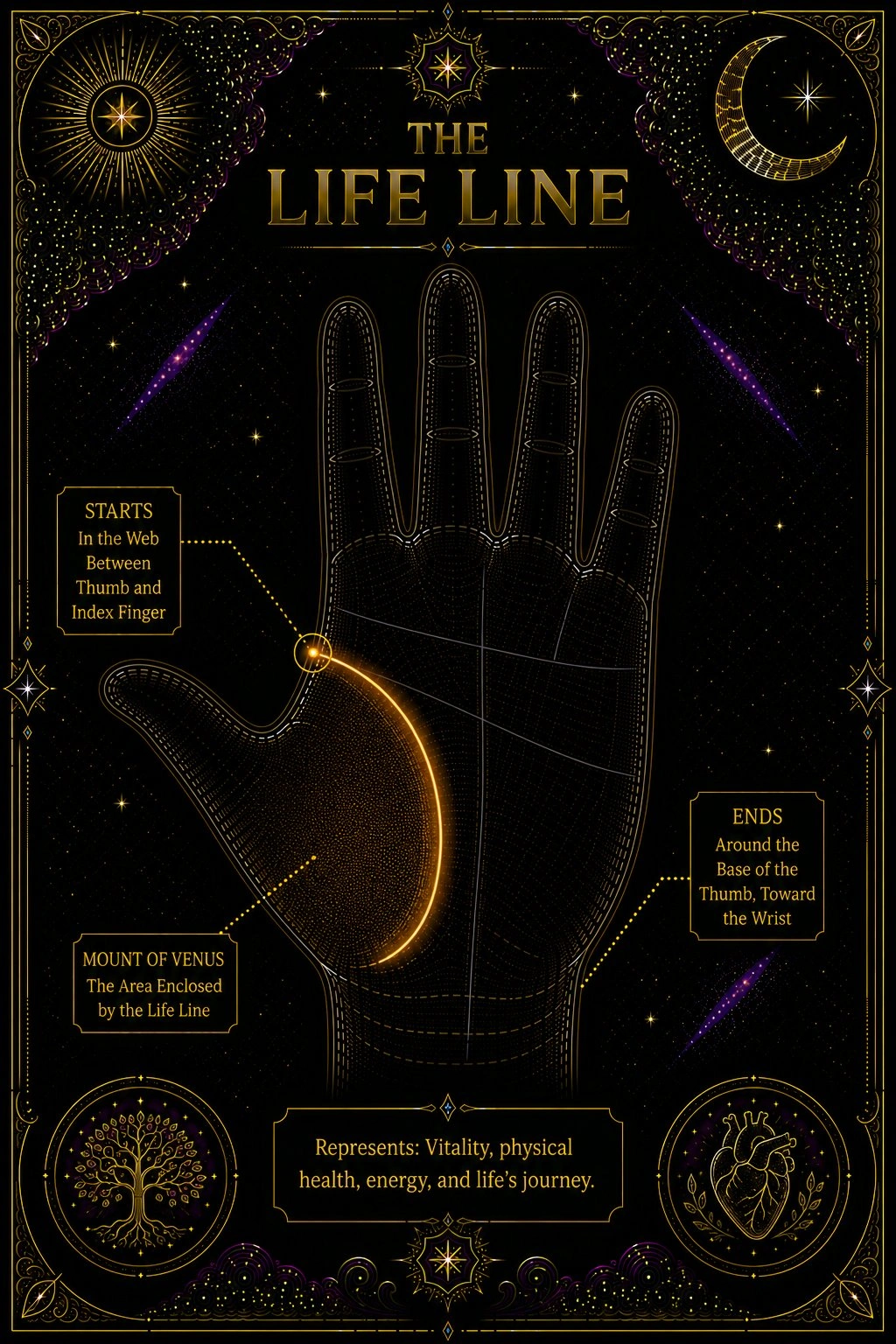
The life line doesn't run horizontally. It arcs — sweeping in a curve around the base of the thumb, from the web between thumb and index finger down toward the wrist. Think of it as framing the fleshy pad at the base of your thumb (this is the mount of Venus; you'll study mounts later).
Some life lines are wide arcs that swing far out into the center of the palm. Others hug the thumb closely and barely venture out. Some are long and unbroken; others are shorter or appear in segments. All of these are normal variation.
You will read the life line for vitality, resilience, and the overall quality of physical energy — not for lifespan. Older writers such as Cheiro and Benham did read it for duration, and the life line lesson covers why that reading was dropped. For now, find the arc and trace it.
The fate line
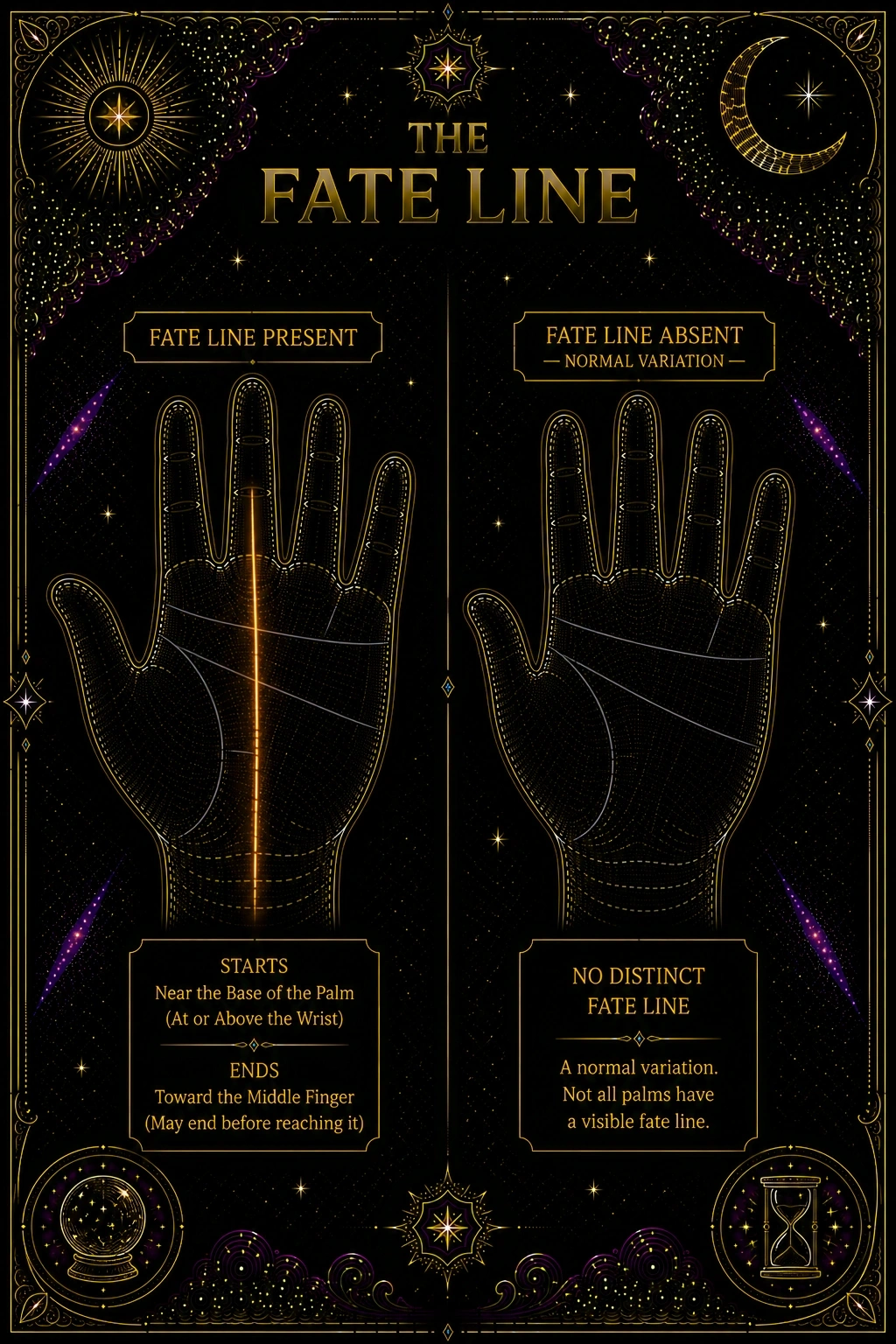
Now look at the center of your palm, running from somewhere near the wrist upward toward the middle finger. Some people have a vertical or near-vertical line running up that center channel. This is the fate line, sometimes called the line of Saturn.
Look carefully before assuming it isn't there — it can be faint, fragmented, or begin midway up the palm rather than at the wrist. But if you don't find one, that is completely unremarkable. A substantial proportion of people have no fate line, or have only a fragment of one. Its absence is not a gap in the hand's record. It simply isn't present.
The fate line is traditionally associated with the direction and structure of a person's life path — how much their life follows a defined course versus remaining more open or changeable. But some practitioners weight it heavily and some barely use it. You will find disagreement across sources. For now, check whether yours is there and, if so, where it runs.
Finding all four at once
Now look at your whole palm again with all four lines in mind.
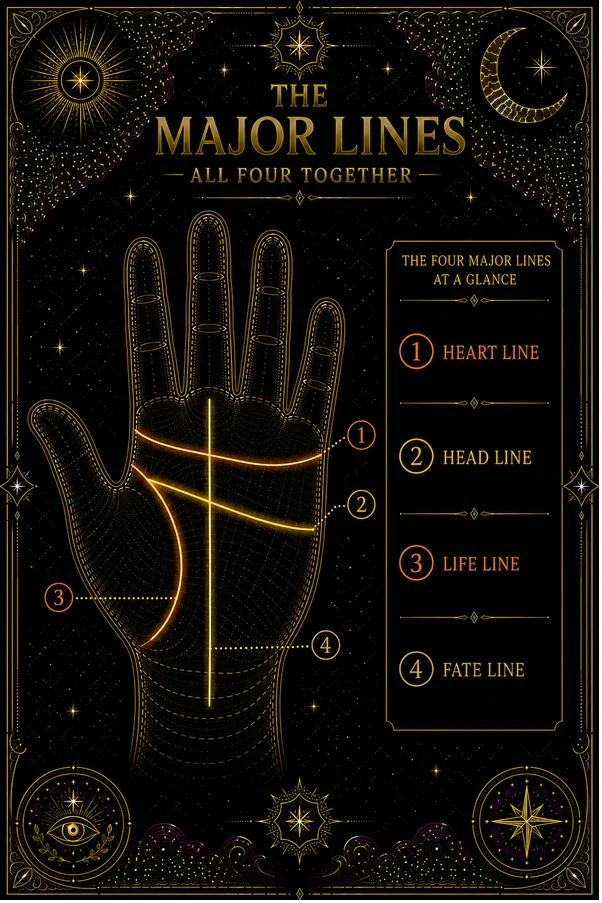
The heart line and head line form a pair of roughly horizontal bands across the upper palm. The life line arcs around the thumb below them. The fate line, if present, cuts vertically up the center between the life line and the outer edge of the palm.
They are a system — not isolated marks but lines that share space, sometimes crossing each other, sometimes running close together, occasionally merging at their origins.
What names you'll encounter
The names used in Western palmistry are stable, but palmistry is a global tradition and other systems name things differently.
In contemporary Chinese palm reading, the three principal lines — heart, head, and life — are framed through the classical Chinese cosmological concept of Tian Di Ren (Heaven, Earth, Human): the heart line as Heaven, the head line as the Human line, and the life line as Earth. The san cai triad itself is well documented; the mapping of it onto these three lines is the terminology found in the contemporary Chinese palm-reading material we have consulted, and is not something this site has traced to a classical text.
In Indian palmistry, within the Hasta Samudrika Shastra tradition, the major lines carry Sanskrit names — the heart line is sometimes called Hridaya Rekha, the head line Manak Rekha or Mastishka Rekha, the life line Jeevan Rekha — and the framework of interpretation carries its own logic that doesn't map cleanly onto Western categories. These are the same physical lines; the interpretive systems built around them are distinct traditions, not competing translations of one truth.
This lesson uses Western names. That is a starting point, not a claim about which system is correct.
Try it: find all four
This is not a reading exercise — not yet. You now have the vocabulary to describe a line's condition, but you are not yet applying it to any particular line — and the variables that differ from line to line, such as length, path, and where a line ends, come in the lessons that follow, one line at a time.
What you are doing is building the spatial foundation that every subsequent lesson assumes. If you can look at a palm and immediately locate all four lines — even in a quick glance — the rest of the work becomes considerably easier.
Take a few minutes with your own hand. Find the heart line. Find the head line. Find the life line. Check for a fate line. Name them, out loud or in your head, as you trace each one. That habit of deliberate location is the first skill in palm reading.
Lesson takeaway: The four major lines are the heart line (uppermost horizontal line), the head line (second horizontal line, below the heart), the life line (arc curving around the base of the thumb), and the fate line (vertical line up the palm's center, not present on all hands). Before interpreting any of them, learn to find them reliably. The lessons that follow cover each line in depth.